
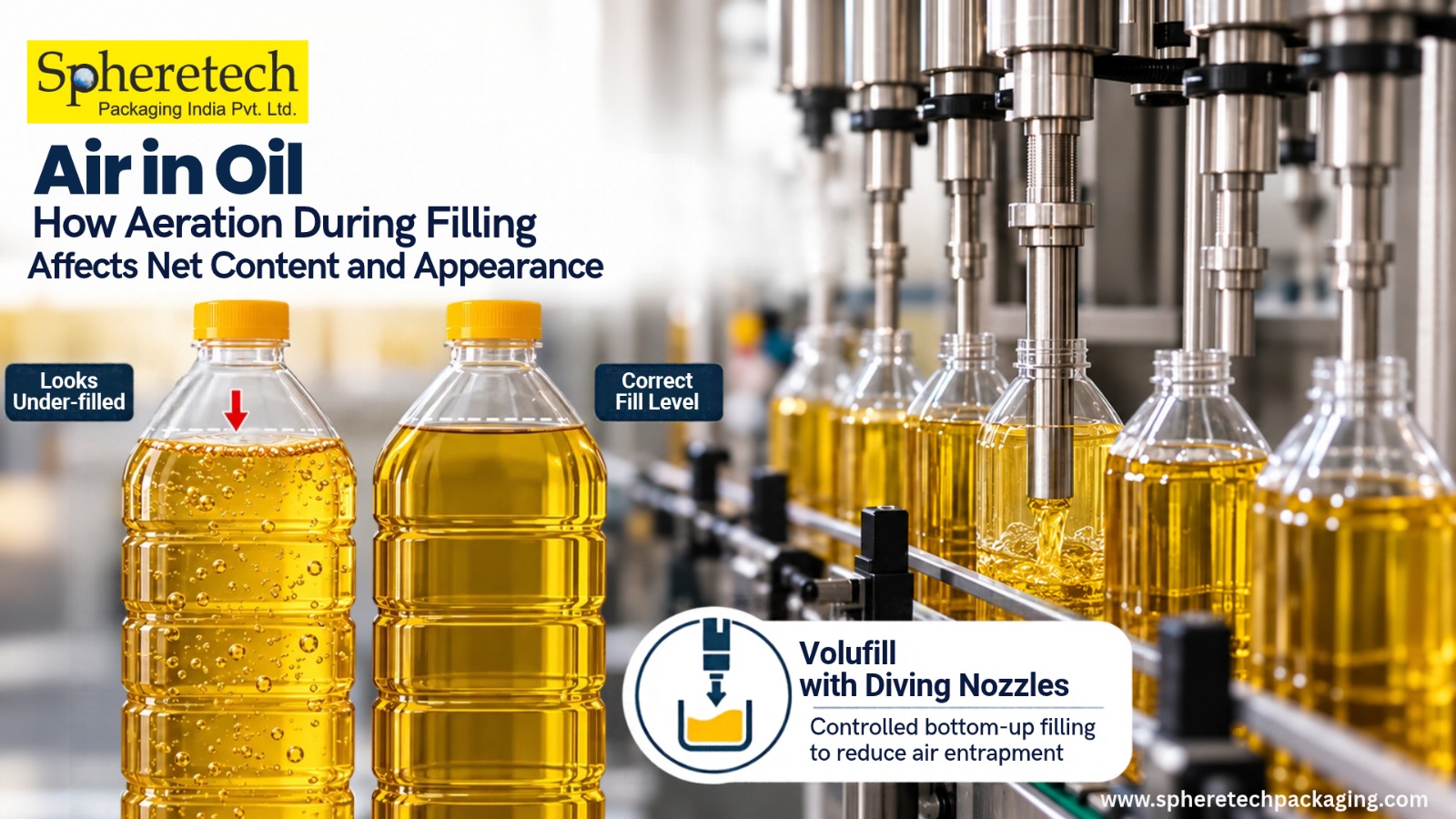
Introduction: The Bottle That Looks Short Even When It Isn’t
Every plant manager in the oil business has seen it. A bottle leaves the filler at the right volume, travels down the conveyor, and by the time it reaches the capping station the level has dropped, and a foamy layer sits on top. The consumer picking it off a shelf sees a half-empty look with a cloudy surface, and quality control sees a rejection.
The cause is rarely a faulty dosing system. It is air. When oil is pushed into a container too aggressively, it carries tiny bubbles with it, and those bubbles change both what the bottle contains and how it looks.
After more than two decades in packaging machinery, we can say with confidence that aeration is one of the most under-discussed causes of rejects in both engine oil and edible oil lines. This article explains where the air comes from, why it matters commercially, and how bottom-up filling with diving nozzles, such as those on the Spheretech Volufill, brings it under control.
Why Air in Oil Is More Than a Cosmetic Problem
It is tempting to treat bubbles as a visual nuisance that settles on their own. In practice, they create three separate problems.
- Net content drifts. Oil that contains entrained air occupies more space than the same quantity of liquid without it. A bottle filled to a visual or level-based mark may therefore carry less actual product than declared. When the bubbles later rise and break, the level falls, and the pack appears short.
- Appearance suffers. Edible oil is sold on clarity and colour. A hazy, bubbly bottle suggests poor quality or even adulteration, however good the oil is. Engine oil is darker and thicker, so the bubbles are less obvious at first, but they linger far longer and give a frothy crown at the neck.
- Downstream operations get harder. Foam at the bottle mouth contaminates the neck and thread area, interferes with induction sealing, weakens cap seating, and leaves oil on the outside of the pack that spoils labels.
Why the Two Oils Behave Differently
Physics are the same, but the symptoms are not.
Edible oils such as sunflower, soybean, mustard and palm are comparatively thin and release bubbles quickly, yet the bubbles are highly visible against a clear liquid. An Edible Oil Filling Machine must also account for seasonal temperature changes, which shift viscosity, so a setting that works in summer may foam in a cold store.
Lubricants are a different story. Higher viscosity slows the rise of trapped air, so bubbles can stay suspended for minutes. Additive packages in finished lubricants can also stabilise foam, which means a bottle that looks acceptable at the filler may still be hazy when it reaches the warehouse. A Lubricant Oil Filling Machine therefore needs a product-specific filling profile.
This is why a single filling profile rarely suits both products, and why product-specific configuration matters.
Why Bottom-Up Filling Helps
A diving nozzle changes where the oil enters the bottle. Instead of letting the stream fall from the top and strike the liquid surface, the nozzle descends towards the bottom of the container and rises as filling progresses.
This approach helps reduce splashing and turbulence at the surface, limiting the air that gets drawn into the oil. For edible oil, this means a clear, bright bottle with a clean neck. For engine oil, whose high viscosity makes trapped air so stubborn, it means avoiding the problem in the first place, since removing bubbles afterwards is slow and unreliable.
Flow Control: The Other Half of the Solution
A diving nozzle alone is not enough. How quickly oil is delivered matters just as much as where it is delivered. Good flow control follows a few principles.
- Start slowly. A soft opening keeps the first oil from hitting the bottle base with force.
- Run fast only when it is safe. Once the nozzle is submerged and the oil has a cushion, the filler can move into a faster bulk stage to protect output.
- Slow down for the finish. The final portion of the fill is where foam is most likely to climb the neck. A reduced flow in this stage keeps the level steady and shortens the settling time.
- Shut off cleanly. A fast-acting, leak-free valve prevents drips, strings of oil and the gulp of air that follows a loose closing.
- Keep supply pressure steady. Fluctuating head pressure changes the flow rate from one cycle to the next, so a stable feed from the buffer tank is essential.
- Match the profile to the product. A thin cold-pressed edible oil and a thick 20W-50 do not need the same ramp. Viscosity, temperature and bottle neck size should all feed into the settings.
This staged approach is how a line can run quickly without paying the price in froth. Speed is not the enemy; uncontrolled speed is.
The Spheretech Volufill Approach
The Volufill, equipped with diving nozzles, is designed around the idea that good filling is gentle as well as accurate. Product enters from the bottom of the container, flow is managed through the fill cycle, and the nozzle retreats without dripping. That makes it a practical choice for manufacturers who want bright, calm bottles of edible oil or consistent, low-foam packs of engine oil.
Spheretech has been building liquid packaging machinery since 2003 and has completed over 3,000 installations. Each system is configured around product viscosity, bottle size, output target and automation level rather than being sold as a one-size-fits-all unit. Our filling range also covers volumetric, piston, rotary level, weighmetric and mass flow technologies, so the right principle can be chosen for the product.
You can explore the dedicated pages for the Edible Oil Filling Machine and the Lubricant Oil Filling Machine for application-specific detail.