
Introduction: How Bottle Material and Wall Thickness Affect Oil Packaging
Most edible oil plants spend months comparing filling machines, yet the bottle that enters the line is often chosen on price and appearance alone. After more than two decades around packaging lines, one lesson keeps repeating: a filler can only perform as well as the container it is given. In edible oil bottle packaging, the plastic you pick, and the thickness of its walls quietly shape how bottles travel on the conveyor, how steadily they fill, and how securely the cap goes on.
This guide is written for edible oil manufacturers, packaging engineers and production managers who run sunflower and soybean oil lines. It explains what PET and HDPE each bring to the line, why wall thickness matters more than most buyers expect, and what to check before you approve a bottle supplier.
Why the Bottle Deserves as Much Attention as the Filler
Sunflower and soybean oil are light, free-flowing liquids, but they are not forgiving. They are sold in large volumes, in tight margin categories, so even a small rejection rate becomes a serious cost over a year. Oil is also unforgiving visually: a slightly dented bottle, a greasy neck or a leaning cap shows up instantly on a shelf.
A bottle affects the line in three places. It must survive handling on conveyors, stay stable under the filling nozzle, and hold its shape while the capper applies torque. When any one of those fails, operators usually blame the machine. Very often the real cause sits in the container.
That is why leading packaging teams treat the bottle and the machine as a single system. It is also the thinking behind Spheretech’s approach: configure the packaging line around the product, the container format and the production target, rather than forcing a generic setup onto whatever bottle arrives.
PET and HDPE: Two Materials, Two Personalities
Both plastics are widely used for cooking oil, but they behave differently on a line.
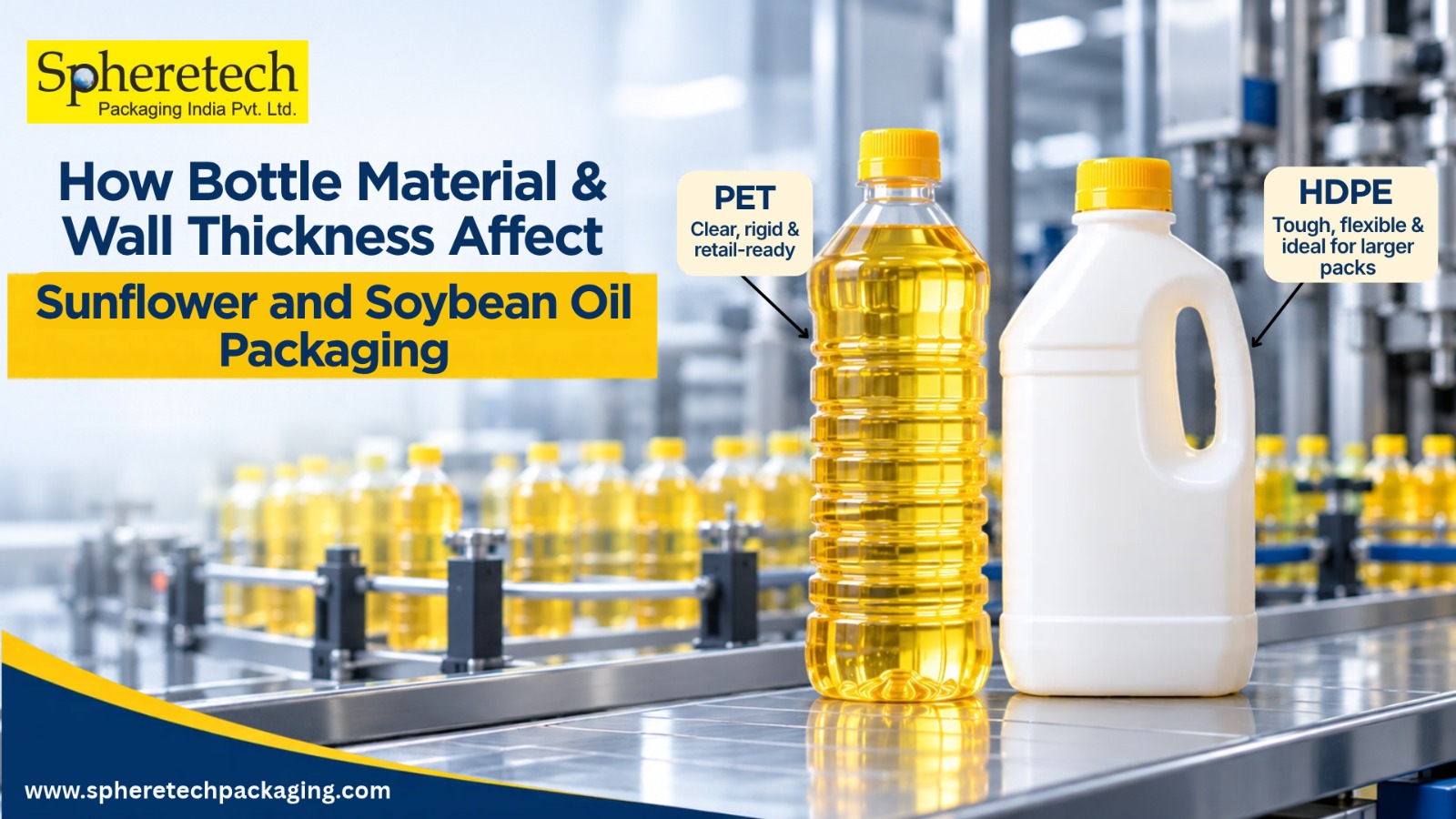
PET (polyethylene terephthalate) is the clear, glossy option. It is stiff, light for its strength and gives the product a premium look, which is why many sunflower and soybean oil brands favour it for retail packs. PET holds its shape well, so bottles stand upright and move predictably. The trade-off is that PET can be less forgiving of sharp impacts at low temperatures and is sensitive to poor preform or blowing quality, which shows up as uneven walls.
HDPE (high-density polyethylene) is usually opaque or semi-opaque and slightly softer. It tolerates knocks well, which suits rough distribution chains and larger jars and jerry-can style packs. Its flexibility is also its weakness on the line: a thin HDPE wall can squeeze under a gripper or a capping chuck, and the bottle may spring back or deform slightly.
Neither is better in absolute terms. The right choice depends on the pack size, the market, the look you want and, importantly, the equipment the bottle will pass through.
Rigidity: The Property Your Line Feels Every Second
When people say “strong bottle”, they usually mean a bottle that does not break. On a high-speed line, what matters more is rigidity, meaning how well the bottle resists bending, squeezing and sagging under normal forces.
Rigidity comes from three things working together: the plastic itself, the design of the bottle (ribs, shoulders, base geometry) and the thickness of the wall. A well-designed PET bottle can feel firm even with a thin wall, while a poorly designed one can feel floppy at the same weight. This is why comparing bottles by weight alone can mislead you.
A rigid bottle behaves the same way every time it meets a guide rail, a star wheel or a nozzle. A less rigid one behaves slightly differently each time, and that variation is what produces intermittent faults that are so hard to diagnose.
How Wall Thickness Changes Conveyor Handling
Bottles spend more time on conveyors than they do under any nozzle, so handling problems tend to appear first.
A thin or inconsistent wall lets bottles flex when they bunch up at a curve or at the infeed of a machine. Instead of sliding neatly, they press into each other, tilt, or jam. Light empty bottles can also tip when air currents or vibration disturb them, particularly in tall, narrow formats.
On the other side, a very thick wall adds weight and cost without helping the line, and it can slow cooling and affect bottle clarity in PET.
Filling Stability: Where Thin Walls Show Their Weakness
Filling looks simple on paper, yet it is sensitive to how a bottle sits and responds in the moment the oil flows in.
Sunflower and soybean oil are poured at relatively low viscosity, so they move quickly, and a bottle that wobbles or flexes under the nozzle can change how the stream enters and how the oil settles. A flexible wall can also bulge slightly as the weight of the liquid builds, which makes level-based filling less repeatable from bottle to bottle.
Several symptoms point back to the bottle rather than the filler:
- Fill levels that drift between bottles even though the filler settings have not changed.
- Foaming or splashing caused by bottles moving as the nozzle enters.
- Oil on the neck or the thread area, which later interferes with capping.
- Air trapped in the oil.
Neck finish also matters here. If the neck diameter, height or inner profile varies from one batch of bottles to another, nozzles do not sit consistently.
Getting the Bottle and the Machine to Work Together
The most reliable results come from deciding the bottle and the machine together. When the packaging engineer, the production manager and the machine supplier review the container early, problems are caught on paper rather than on the shop floor.
Spheretech designs and supplies filling, capping, sealing, labelling and end-of-line machines, and configures them around the product, the container format and the required capacity. With more than 23 years of experience and over 3,000 installations across multiple industries, the team works with manufacturers to match the line to the bottle they plan to use.
If you are choosing between PET and HDPE, or reviewing a new bottle for an existing line, you can contact the Spheretech team to discuss your requirements.
Conclusion
Choosing the right bottle is one of the quietest, most valuable decisions in edible oil bottle packaging. The material decides how the bottle behaves, the wall thickness decides how consistently it behaves, and the supplier decides whether it keeps behaving that way over time. Get these three rights, and your conveyors run smoothly, your filler stays accurate and your caps seat properly, bottle after bottle.