
Packaging Engine Oil and Gear Oil: Different Filling Requirements Explained
Engine oil and gear oil often share a warehouse, a brand and even a bottle style. On the filling line, though, they behave like two different products. A line tuned perfectly for 1-litre engine oil packs can struggle the moment a thicker gear oil is introduced. Fill volumes drift, nozzles drip and bottles come off the line with oil running down the neck. The lesson is simple: choose the machine for the liquid, not just for the bottle.
How Engine Oil and Gear Oil Behave on a Filling Line
Engine Oil: Free-Flowing but Prone to Foam
Engine oil is designed to circulate quickly through a running engine, so it flows freely. Common grades such as 5W-30, 10W-40 and 15W-40 are medium in viscosity and move easily through pipes, valves and nozzles. That allows faster fills and higher line speeds, usually in packs from 500 ml to 5 litres. An Automatic Engine Oil Filling Machine can support these packaging operations by providing controlled and consistent filling according to the selected machine configuration.
The main challenge is air. Agitation and sudden valve action create bubbles, and the resulting foam at the bottle neck can cause false level readings and underfilled packs.
Gear Oil: Thick, Sticky and Slow to Settle
Gear oil is built to cling to metal under heavy loads. Grades like 80W-90 and 85W-140 are much thicker, and many contain extreme-pressure additives that make the oil sticky and stringy. This slows filling and leaves a thread of oil as the nozzle lifts away, causing drips on the bottle shoulder. Air escapes slowly, so a bottle can look full while still holding bubbles. Cold weather thickens the oil further, and packs tend to be larger, from 5 litres to 20 litres, 50 litres and drums.
Key Differences at a Glance
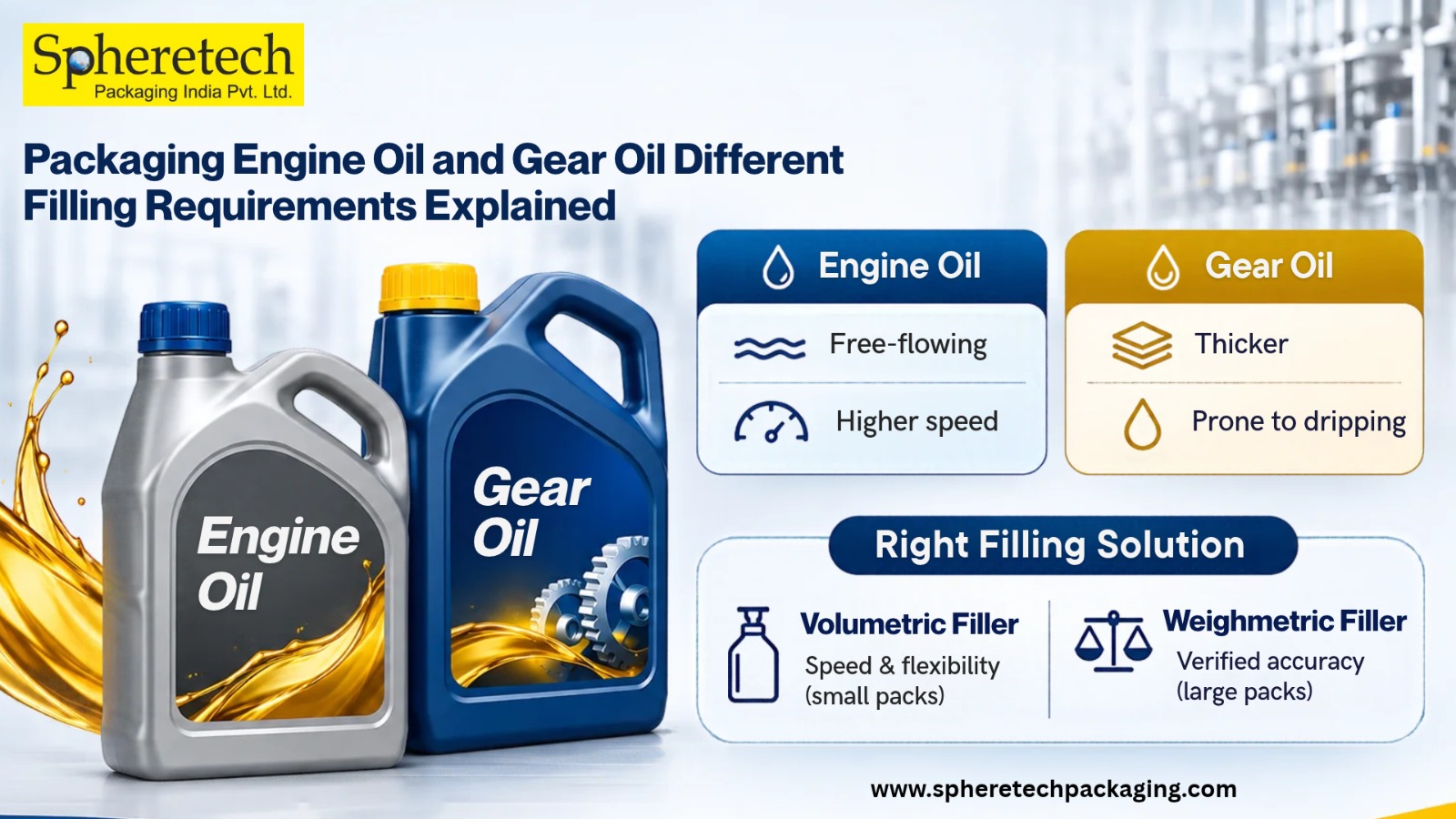
Engine oil is free-flowing, packed in smaller containers, and prone to foaming and splashing. It supports higher speeds, and changeovers are easy to clean.
Gear oil is thick and sticky, packed in larger containers, and prone to dripping and slow fill. It runs at moderate speeds, is sensitive to temperature, and leaves residue that needs more thorough cleaning.
Choosing Between Volumetric and Weighmetric Filler Machines
Volumetric Filler Machine: Speed and Flexibility
A volumetric filler dispenses a set volume with each stroke, usually through positive displacement. Because it physically moves a measured quantity, it handles viscous liquids well. For engine oil in retail packs, it offers a strong balance of speed, repeatability and quick changeover. Operators can move from 500 ml to 1 litre to 4 litres by adjusting the recipe, which suits blenders running many SKUs in one shift.
For gear oil in smaller bottles, positive displacement pushes thick product through with controlled force, and anti-drip nozzles stop strings of oil reaching the neck.
Spheretech’s volumetric range includes a true-volume setting system that helps operators set and repeat fill quantities with confidence.
Choose volumetric filling when you run multiple pack sizes, work with small to medium containers, and value speed and consistent volume.
Automatic Weighmetric Filler Machine: Verified Accuracy
A weighmetric filler measures what actually goes into the container. Load cells track weight in real time, and the machine stops flow when the target is reached. Because weight is measured directly, the result isn’t thrown off by foam, trapped air, temperature-driven density changes or batch-to-batch viscosity differences. A bottle that looks full but holds air still receives the correct amount of oil.
This makes weighmetric filling ideal for large gear oil packs of 20 litres and above, premium engine oil brands that need documented accuracy, and plants that sell by weight.
The trade-off is cycle time, since weighing needs a moment to stabilise, so it suits larger containers better than very high-speed small-bottle lines. Most systems use a fast bulk fill followed by a slow dribble to land exactly on target.
Which Machine Suits Which Product?
Retail engine oil in 500 ml to 5-litre packs, especially across multiple SKUs, suits a volumetric filler.
Gear oil in 1-litre to 5-litre bottles also works well on a volumetric filler with anti-drip nozzles.
Once gear oil moves into 20-litre pails, 50-litre containers or drums, an automatic weighmetric filler is the stronger choice. The same applies to premium or industrial grades that demand tight accuracy.
Many manufacturers use both, with volumetric machines for small packs and weighmetric machines for bulk.
Final Thoughts
Engine oil flows fast and foams easily. Gear oil resists flow, clings to surfaces and often arrives in larger containers. Treating them the same leads to slow lines, messy packs and product giveaway. Volumetric fillers bring speed and flexibility for smaller formats, while automatic weighmetric fillers bring verified accuracy for heavy, high-value packs.
With 23+ years of experience and 3,000+ installations, Spheretech Packaging helps manufacturers match filling technology to the product, container and output target. When choosing an Engine Oil Filling Machine Supplier, manufacturers should consider the lubricant grade, required pack sizes, filling technology and production output.
Explore our Lube Oil Filling Machine and Filling Machines pages, or contact our team with your grade, pack sizes and output target for a tailored recommendation.