
Preventing Leakage in Lubricant Packaging: Filling, Capping and Induction Sealing Explained
Imagine a shipment of engine oil bottles reaching a distributor after a long journey. A few cartons have oil stains around the corners. The product inside may be perfectly fine, but the packaging creates a poor first impression.
For lubricant manufacturers, this is more than a minor packaging issue. Leakage can lead to product wastage, damaged cartons, customer complaints and loss of brand confidence.
Preventing these problems requires attention to three important operations: filling, capping and induction sealing. Although each has a separate function, their performance is closely connected. Selecting the right Lubricant Oil Filling Machine, capping equipment and sealing system helps manufacturers maintain consistent packaging quality.
Why Lubricant Packaging Needs Careful Attention
Packaging lubricants can be challenging because oils tend to cling to surfaces and leave residue around bottle openings. Even a small amount of oil on the bottle neck can interfere with cap tightening or affect the induction seal. The problem may not always be with the sealing machine. It could begin during filling, when product splashes onto the bottle threads, or during capping, when the closure does not sit correctly.
Understanding how these processes work together is the first step towards reducing leakage.
1. Filling: Getting the Product Into the Bottle Correctly
Filling is where packaging quality begins. The machine must deliver the required quantity while keeping the bottle opening clean enough for the next operation.
The choice of Lubricant Oil Filling Machine depends on the lubricant’s properties, container size and production requirements.
Volumetric Filling – Volufill
Spheretech’s Volufill uses proprietary flow-meter technology to dispense a controlled volume of lubricant. It handles pack sizes from 200 ml to 5 litres and 5 to 15 litres without change parts.
Weighmetric Filling – Weighfill
For larger lubricant containers, weight-based filling offers a practical approach. Weighfill uses load-cell technology to measure the actual product weight and supports containers from 5 kg to 30 kg and above.
Automatic tare, positive cut-off nozzles and drip collection trays help maintain controlled filling and minimise product spillage.
Rotary Monoblock Filling
When production speed is a priority, a rotary monoblock combines filling and capping within a single machine frame. This reduces bottle transfers between operations and supports a continuous packaging flow.
2. Capping: Getting the Closure Right
Once filling is complete, the bottle moves to the capping station. The objective is simple: secure the cap without damaging the bottle neck or closure.
A loose cap can allow oil to escape during transportation. Excessive tightening, on the other hand, can damage threads or deform the liner.
The capping system must therefore match the closure design.
- Screw Capping Machine: For threaded bottle caps.
- Press-On Capping Machine: For push-on closures.
- Linear Servo Capper: For controlled and repeatable capping operations.
Regular torque testing is also important. Checking sample bottles helps manufacturers identify inconsistent tightening before it affects the finished product.
3. Induction Sealing: Adding Protection Beneath the Cap
A properly fitted cap is important, but some lubricant applications require an additional sealing layer. An Automatic Induction Sealing Machine provides this additional sealing operation by bonding a foil liner to the bottle opening.
Induction sealing uses an aluminium foil liner placed inside the bottle cap. As the capped bottle passes beneath the induction sealing head, electromagnetic energy heats the foil and activates its sealing layer, bonding it to the bottle rim. The quality of the seal depends on several factors, including bottle material, cap design, foil compatibility and machine settings. Too little heat can result in incomplete bonding, while excessive heat may damage the sealing layer. Oil residue around the bottle opening can also affect adhesion. Testing the actual bottle, cap and foil combination is therefore essential before finalising production settings.
How These Three Operations Work Together
A reliable lubricant packaging line depends on the smooth coordination of all three stages.
The filling machine must leave the bottle ready for capping. The capper must apply the closure correctly, allowing the Automatic Induction Sealing Machine to create a consistent bond.
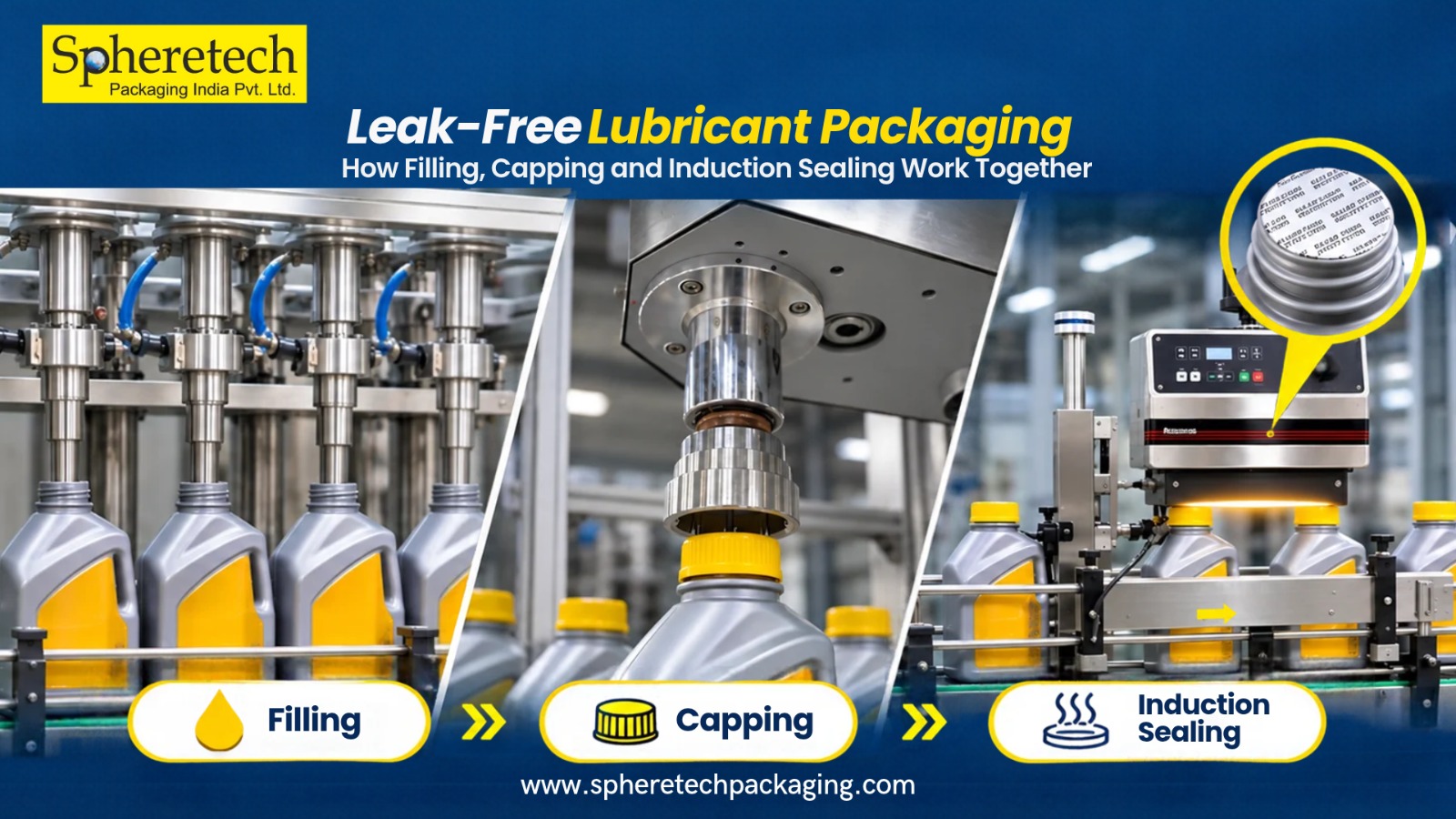
A typical packaging sequence includes:
- Filling: Accurate product dispensing with minimal splashing.
- Capping: Secure application of the selected closure.
- Induction Sealing: Bonding the foil liner to the bottle opening.
When these operations are properly matched, manufacturers can reduce handling issues and improve the consistency of finished packs.
Reliable Lubricant Packaging Starts with the Right Combination
A leak-free bottle is the result of several operations working correctly, not just one machine performing its job.
From accurate filling to secure capping and effective induction sealing, every stage contributes to the final packaging quality.
Spheretech Packaging offers integrated bottle packaging solutions covering liquid filling, capping, induction sealing, labelling and end-of-line automation. Its Lubricant Oil Filling Machine solutions and automatic induction sealing equipment can be considered as part of a packaging line based on the product and container requirements.
Whether you are packaging engine oil, gear oil or other lubricants, selecting equipment according to your product, container and production requirements is essential.